

About and contact
I started learning Android development at a vocational school in Malang and opened my GitHub account in 2016. Through school and Telkom University, I earned 20 competition placings, including seven first places, in work ranging from chatbot prototypes to data science and capture-the-flag.
I helped lead a 200-student programming club, trained an IndoBERT model for campus sentiment analysis and supported myself with part-time e-commerce backend work. At MNC, Jatis and Jenius, I built travel payments, multi-tenant SaaS and digital-banking integrations. In 2026, I joined Metrodata's Microsoft AI practice. I now write the specs, direct AI coding agents in parallel and review their work before merging. I build voice agents that callers can interrupt mid-sentence, a security platform that opens fix PRs and document AI that must not guess. Alongside that, I build Indonesian-language Terminal-Bench tasks for LILT AI that test whether frontier AI agents handle Indonesian conventions. Evaluation determines which changes I release.
I am open to freelance or part-time work in software and AI engineering.
Email: kurniadiahmadwijaya@gmail.com- Jakarta, IndonesiaGMT+7
Contact links
Working approach
I define each feature in a written spec with acceptance criteria. GitHub Copilot, Claude Code and Codex implement much of the code in parallel; I remain responsible for design, review, verification in a deployed environment and the merge. I use gold sets, A/B tests, CI gates and shadow mode to evaluate changes, and report metrics with their measurement method. Exact logic stays in deterministic code, and an LLM feature is done only when it is evaluated, guarded and observable.
Define the Spec First
Before implementation, I write a numbered spec with acceptance criteria and a constitution: the working rules every agent must follow.
Delegate Implementation, Own the Review
AI coding agents implement much of the code in parallel. I am responsible for design, review, verification in a deployed environment and the merge decision.
Evaluate Before Release
I evaluate changes with gold sets, A/B tests, CI gates and shadow mode. I record negative results and leave changes disabled when they do not help.
Design for Recovery
I plan for failures and build a recovery path rather than assume the system will always work.
Report Metrics with Context
I publish a metric only when I can explain how it was measured: in the lab, offline or live.
How I run AI in production
I treat observability as part of the feature, not an afterthought. The AI services I run on Azure are instrumented with OpenTelemetry, mostly through the Azure Monitor distro, on Python (FastAPI, Functions) and Node (Next.js), across App Service, Functions and Container Apps.
LLM telemetry with GenAI conventions. Each model call records token usage (including reasoning and cached tokens), model, provider and agent, so cost and latency can be traced per feature.
Alerts as code. Alert rules, action groups and diagnostic settings live in Bicep next to the app and ship with azd: 44 rules in production today, covering daily and month-to-date spend, reasoning-token spikes, 429 throttling per deployment, judge latency and failed evaluation gates.
Telemetry governance. Personal data is redacted before export. Noisy spans are sampled, and ingestion has a daily cap with an alert at 80 percent.
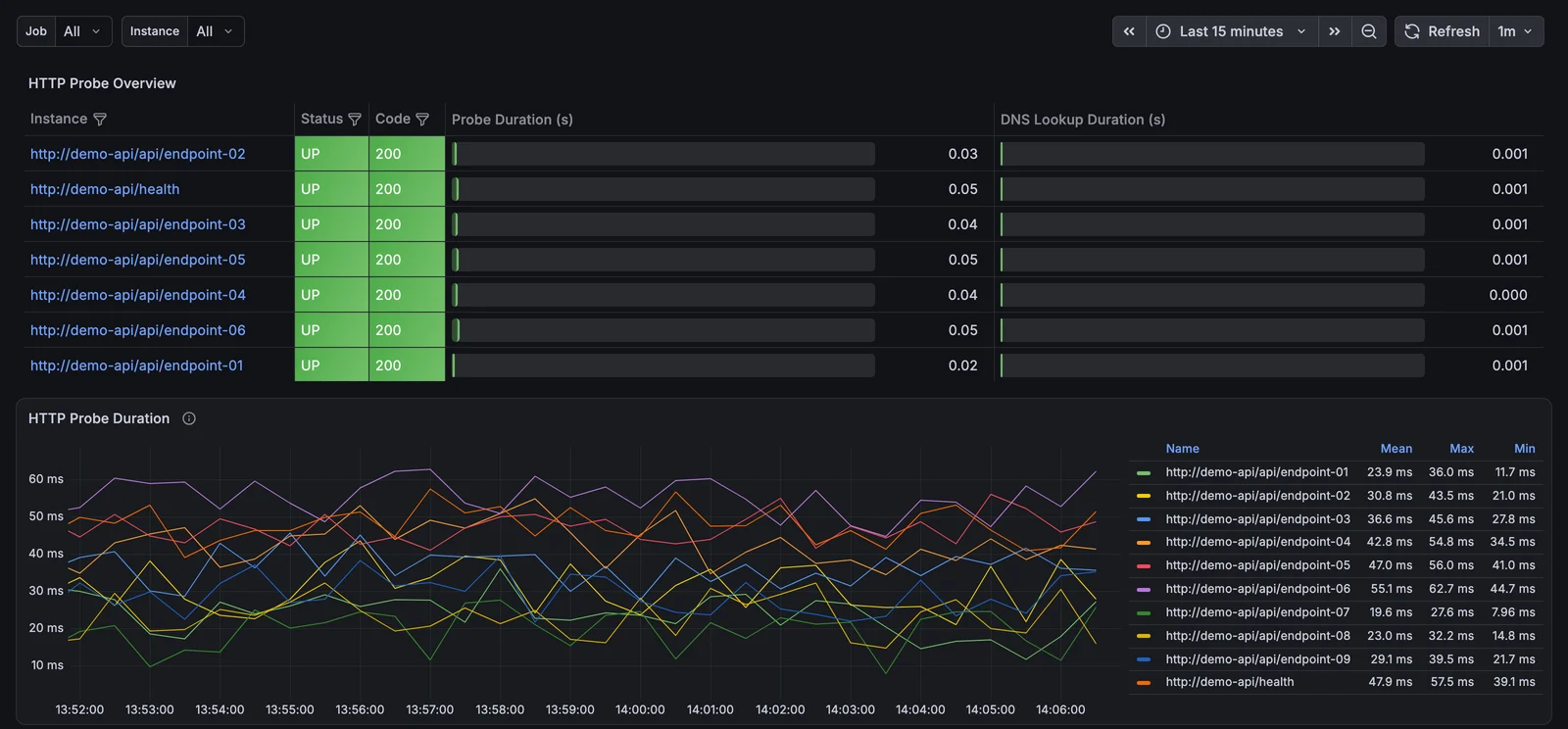
Self-hosted when it fits. For a ticketing marketplace backend I provisioned Prometheus and Grafana as code, with black-box probes on the public API every 5 seconds plus Postgres, Redis and host metrics.
This site is also monitored: an anonymous performance beacon, nightly performance runs, and public visit stats at the Visitor Observatory in the Lobby.
Proof from production
100%
of surveyed AI services
44
in production, defined in Bicep across 7 repos
3
production AI services
~1.2M
per month on one queue-based scanner
10
public endpoints every 5 s
param databaseAccountName string
param actionGroupId string

@description('429 responses per 15 minutes that fire the alert.')
param throttleThreshold int = 50

resource database 'Microsoft.DocumentDB/databaseAccounts@2025-10-15' existing = {
  name: databaseAccountName
}

resource throttling 'Microsoft.Insights/metricAlerts@2026-01-01' = {
  name: '${databaseAccountName}-throttling'
  location: 'global'
  properties: {
    description: 'Cosmos DB returned 429 TooManyRequests above the threshold in 15 minutes.'
    severity: 3
    enabled: true
    scopes: [database.id]
    evaluationFrequency: 'PT5M'
    windowSize: 'PT15M'
    autoMitigate: true
    criteria: {
      'odata.type': 'Microsoft.Azure.Monitor.SingleResourceMultipleMetricCriteria'
      allOf: [
        {
          criterionType: 'StaticThresholdCriterion'
          name: 'throttled'
          metricNamespace: 'Microsoft.DocumentDB/databaseAccounts'
          metricName: 'TotalRequests'
          dimensions: [{ name: 'StatusCode', operator: 'Include', values: ['429'] }]
          operator: 'GreaterThan'
          threshold: throttleThreshold
          timeAggregation: 'Count'
        }
      ]
    }
    actions: [{ actionGroupId: actionGroupId }]
  }
}
One alert rule as code, masked: Cosmos DB 429 throttling from the AI code security platform. Names are placeholders.
Related case studies
- AI Code Security PlatformPris.AI, MII's AI code security platform: eight scanners per pull request, readable AI triage and a fix agent that opens PRs with validation and guardrails.
- Realtime Voice AI Contact CenterARIA, MII's voice AI contact center: ~2 s to ~0.2 s interruption latency in a controlled A/B (n=4 calls per arm), grounded answers and human handover.
- AI Fraud Document ReviewMII Fraud Detection: OCR and two-pass LLM procurement review, with offline development-set evaluation. The hybrid engine remains in shadow mode only.
- Shared Azure AI OperationsModel migration in one day, coordinated key rotation, alerts managed as code and a Node.js security patch sweep across AI apps.
- Event Ticket Marketplace BackendA live ticket marketplace backend for auctions, resale, wallet accounting and partner settlement.
Skills
AI and LLM
 Microsoft Agent Framework
 LangGraph
 LangChain
 Azure OpenAI (incl. Realtime)
 Prompt Shields
 Hugging Face
- RAG
- Hybrid/Vector Search
- LLM evaluation
Data science and ML
 pandas
 NumPy
 Matplotlib
 Seaborn
 Plotly
 Streamlit
 Jupyter
 scikit-learn
 PyTorch
- Hugging Face Transformers
 Keras
- Sastrawi
Azure
 Azure AI Foundry
 Azure AI Search
 Cosmos DB
 Document Intelligence
 Azure Container Apps
 Azure App Service
 Azure Functions
 Service Bus
 Key Vault
 Managed Identity
 Microsoft Fabric
 Azure Monitor
Languages
 Python
 TypeScript
 JavaScript
 Go
 Java
 PHP
Backend
 FastAPI
 Spring Boot
 Express.js
 Gin
 Echo
 Laravel
 CodeIgniter
 Flask
 Django
 GraphQL
Frontend
 Next.js
 React
 Vue
 Nuxt
 Tailwind CSS
Data and messaging
 PostgreSQL
 MySQL
 MongoDB
 Firebase
 Redis
 Kafka
 RabbitMQ
 Elasticsearch
DevOps
 Docker
 Bicep
 GitHub Actions
 Jenkins
 AWS
 LiveKit
 k6
 SonarQube
 Sentry
Certifications
- GH-300
 GitHub, Oct 2026
- GH-600GitHub, Oct 2026

- AI-103
 Microsoft, Sep 2026
- AI-901Microsoft, May 2026
- AZ-900Microsoft, May 2026
- AB-100Microsoft, Nov 2026In progress
Visits
Visits counted by the site itself and AI question totals: today live, earlier days refreshed every hour.
Loading visit stats
CV kiosk
Read my CV here, or download the PDF.